




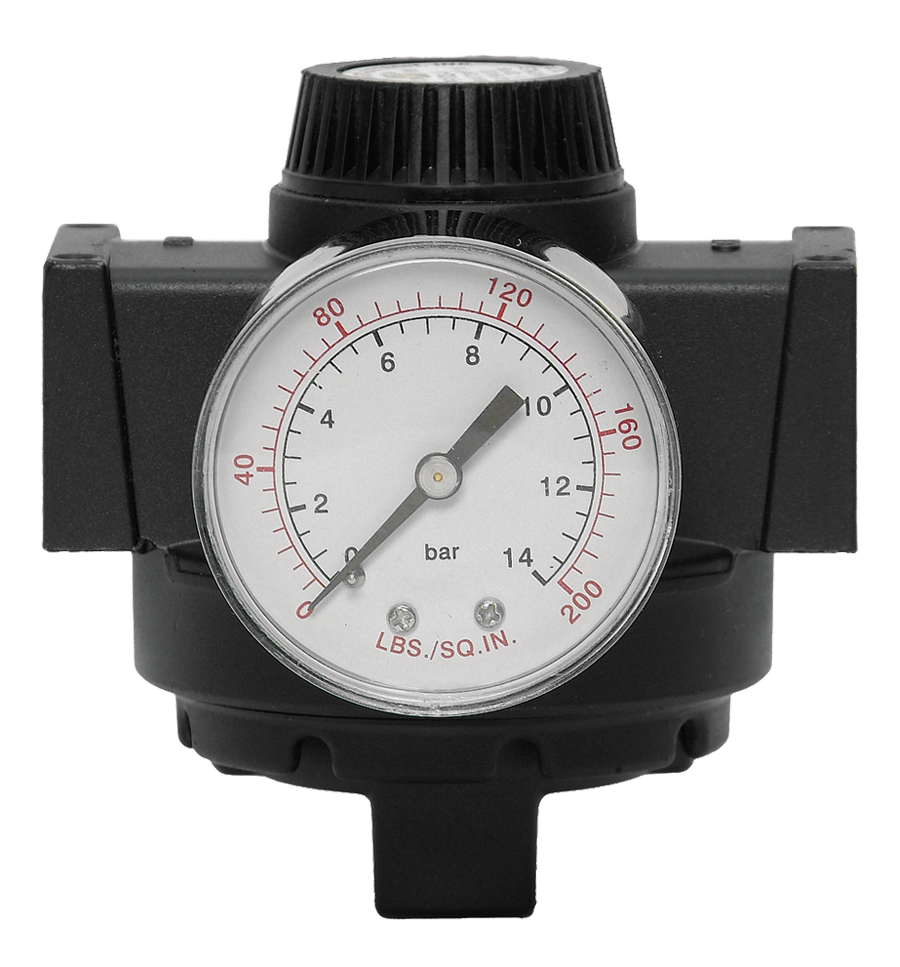
Full-Size Series Remote Pilot Reg Port Sizes 1/4" to 3/4"; Flow to 155 scfm (4490 l/min)
 Product Catalog
- Modular mounting
- Diaphragm construction
- Self-relieving
loading...
loading...
Product Overview
The ROSS Controls is a family of full-size modular remote pilot pressure regulators that provide accurate pressure control in applications where the main regulator body is installed in a location that is physically inaccessible, hazardous, or difficult to reach for set point adjustment. Remote pilot regulators use the output pressure of a small, remotely mounted pilot regulator to set the downstream pressure of the larger main body, allowing operators to adjust system pressure from a safe, convenient location away from the regulated point.
Available in 1/4", 3/8", 1/2", and 3/4" port sizes, the series delivers flow up to 155 scfm (4490 l/min) with regulated output pressure from 0 to 200 psig (0 to 14 bar) dependent on the pilot regulator setting. The main body uses diaphragm construction and is self-relieving, with a 1/4" NPTF pilot supply port for connection to the small pilot regulator. The pilot signal line can be routed over substantial distances, allowing the adjustment point to be located at an operator panel, control room, or other accessible location.
The Series is designed for modular mounting within the ROSS FRL product family, enabling direct connection to upstream filters and downstream lubricators without pipe fittings. The modular design simplifies system construction and maintenance while the remote pilot capability addresses the accessibility challenge. High-relief and premium high-relief variants extend the system's capability to higher pressure differentials and broader pressure ranges when the standard configuration does not meet application requirements.
The Series occupies the same body platform as the 121 Series Full-Size Precision Regulator, sharing port spacing, dimensions, and accessories. This allows engineers who are familiar with the 121 Series to transition to remote pilot operation without changes to panel layouts, mounting hardware, or FRL manifold designs.
Key Engineering Features
- Remote Pressure Set Point Adjustment - Main regulator body pressure is set by a small remote pilot regulator connected via the 1/4" NPTF pilot port, allowing operators to adjust system pressure from a convenient remote location without accessing the main body installation point.
- Modular Mounting Compatibility - Designed for direct integration into ROSS full-size FRL modular manifold assemblies, connecting to upstream filters and downstream lubricators without pipe fittings for compact and maintainable system construction.
- Self-Relieving Diaphragm Design - Diaphragm construction with self-relieving operation allows downstream pressure to vent back through the main body when pilot pressure is reduced, preventing pressure buildup above the commanded set point.
- Flow to 155 scfm - Provides flow capacity to 155 scfm (4490 l/min) at 3/4" port size, matching the 121 Series full-size precision regulator and supporting multi-tool and multi-actuator circuits at the remotely regulated pressure.
- Pilot Port for Remote Connection - 1/4" NPTF pilot supply port accepts the output line from the remote pilot regulator. Pilot signal pressure directly commands the main body outlet pressure, enabling precise, proportional remote control of downstream pressure.
- High Inlet Pressure Rating - Accepts inlet supply pressures up to 300 psig (21 bar), accommodating high-pressure headers while delivering regulated working pressure commanded by the remote pilot signal.
- Dual Gauge Ports - 1/4" NPT gauge ports front and rear allow pressure monitoring at the main body. In remote pilot installations, a gauge at the main body confirms that commanded pilot pressure is being accurately reproduced downstream.
- High-Relief and Premium Variants - High-relief variants handle large differential pressure drops with higher spring force for stable regulation at extreme inlet-to-outlet pressure differentials. Premium high-relief variants extend inlet rating to 400 psig (28 bar) with Fluoroelastomer seals for demanding applications.
- Panel Mount Capability - Compatible with 2-1/16" (52 mm) panel cutout for flush mounting in control panels, with the remote pilot connection point accessible to the operator at the panel face.
- NPTF and G Thread Standards - All port sizes available in both NPTF and G (BSPP) thread standards for worldwide installation compatibility.
Technical Specifications
General Specifications
| Parameter | Specification |
| Series | Full-Size Remote Pilot |
| Construction | Diaphragm, Self-relieving |
| Mounting | Modular or inline |
| Port Sizes | 1/4", 3/8", 1/2", 3/4" |
| Thread Types | NPTF (American) and G (BSPP/ISO) |
| Maximum Flow | 155 scfm (4490 l/min) |
| Inlet Pressure (Maximum) | 300 psig (21 bar) standard; 400 psig (28 bar) premium variant |
| Outlet Regulated Pressure Range | 0 to 200 psig (0 to 14 bar) set by pilot regulator |
| Pilot Port Size | 1/4" NPTF |
| Pressure Gauge Port | 1/4" NPT, front and rear |
| Pressure Gauge (optional) | 0 to 200 psig (0 to 14 bar) |
| Panel Mounting Hole | 2-1/16" (52 mm) diameter |
| Flow Media | Filtered compressed air |
| Body Material | Zinc |
| Dome Material | Zinc |
| Knob Material | Acetal |
| Seal Material | Nitrile (standard); Fluoroelastomer (premium variant) |
| Valve Material | Brass |
| Valve Cap Material | Nylon |
| Dimensions (L x H x W, less gauge) | 3.5" x 2.4" x 1.3" (89 x 62 x 33 mm) |
| Depth (less gauge) | 2.8" (71 mm) |
| Weight (less gauge) | 2.06 lb (0.92 kg) |
Temperature Ratings
The Series standard configuration operates at higher ambient temperature than the miniature and precision series, rated to 175 F (79 C). Premium high-relief variant extends to higher inlet pressures with Fluoroelastomer seals.
| Configuration | Ambient Temperature | Media Temperature |
| Standard and High-Relief (Nitrile) | 40 to 175 F (4 to 79 C) | 40 to 175 F (4 to 79 C) |
| Premium High-Relief (Fluoroelastomer) | 0 to 158 F (-18 to 70 C) | 0 to 158 F (-18 to 70 C) |
Flow Performance Data
Flow performance measured at 100 psig (7 bar) inlet pressure. Maximum 155 scfm at 3/4" port. Flow capacity is proportionally lower at smaller port sizes.
| Port Size | Max Flow scfm (l/min) | Inlet Pressure psig | Pilot Port | Weight lb (kg) |
| 1/4" | ~55 (1558) | 300 max | 1/4" NPTF | 2.06 (0.92) |
| 3/8" | ~90 (2549) | 300 max | 1/4" NPTF | 2.06 (0.92) |
| 1/2" | ~130 (3682) | 300 max | 1/4" NPTF | 2.06 (0.92) |
| 3/4" | 155 (4490) | 300 max | 1/4" NPTF | 2.06 (0.92) |
Certifications & Compliance
| Certification/Standard | Detail |
| Thread Standards | NPTF per ANSI/ASME B1.20.3 and G (BSPP) per ISO 228-1 for main and pilot ports. |
| Modular System Compatibility | Compatible with ROSS Controls full-size FRL modular manifold platform, sharing port spacing and accessories with the 121 Series. |
| CE Marking Eligibility | Designed for compliance with EU Machinery Directive. Consult ROSS Controls for specific documentation. |
Typical Applications & Industries
Inaccessible or Hazardous Location Installations
- Regulator bodies installed inside machine enclosures, behind access panels, or in overhead ductwork, where physical access for set point adjustment is impractical during normal operation. The pilot signal line is routed to a conveniently located adjustment point on the machine exterior.
- Hazardous location installations in areas classified for flammable gases or vapors (ATEX/NEC Division zones) where the main regulator body can be located inside the classified area while the pilot adjustment point is located in a safe non-classified area.
- Regulator bodies installed in areas with exposure to extreme heat, vibration, or chemical atmospheres where repeated human access is undesirable. Operators adjust pressure remotely from a comfortable control station.
- High-pressure systems where the main regulator handles high-pressure supply in a guarded area, and the pilot adjustment is located outside the guarded zone for safety during pressure adjustments.
- Cryogenic or cold-room installations where regulator bodies are located inside refrigerated spaces and pilot adjustment is performed from outside the cold area.
Process Industries and Chemical Plants
- Chemical plant pneumatic actuated control valve supply regulation where the main regulator is located at the valve installation point in the process area and the pilot adjustment is at the control room or local control panel.
- Petroleum refinery and petrochemical facility instrument air regulation for pneumatic control systems where process area access is restricted and all pressure adjustments must be performed from designated operator stations.
- Water treatment and wastewater facility supply regulation for aeration blowers, actuated valves, and process controls, with remote adjustment from central control rooms.
- Pharmaceutical manufacturing supply regulation where pressure adjustments in clean room or controlled environments must be performed from outside the controlled area to maintain environmental integrity.
- Spray drying and powder processing supply regulation where the main regulator is installed close to the process equipment in a dusty environment, while remote adjustment is from a clean control area.
Centralized Pressure Control Systems
- Multi-zone facility air supply systems where each zone's regulator is remotely adjusted from a central operations room, allowing one operator to adjust all zone pressures without traveling to each regulator location.
- Automated machine tools where pressure set points change between operations or parts based on recipe or program, controlled by a pilot regulator driven by an I/P transducer or pneumatic controller output.
- Programmable pneumatic systems where the pilot supply comes from a precision electro-pneumatic transducer, allowing digital control systems to set downstream pneumatic pressure proportionally and precisely.
- Batch process pressure control where different batch recipes require different working pressures, adjusted by remotely changing the pilot regulator set point via a pneumatic controller or manual dial station.
- Redundant supply systems where two Series regulators are installed in parallel with switching valves, allowing seamless transfer between regulators for maintenance without process interruption, with both pilot adjustments accessible from a single remote panel.
Automotive Paint and Assembly
- Paint booth supply regulation where the main regulator serves atomizing air in the paint spray zone and the pilot adjustment is outside the spray booth at the operator station, keeping personnel out of the paint zone during pressure adjustments.
- Robot weld cells where compressed air supply regulators for pneumatic actuators are inside the robot guard envelope, remotely adjusted from the safety door without needing to enter the cell.
- Press area supply regulation where regulators inside the stamping press guarded area are adjusted remotely from the operator panel outside the safety fence.
- Assembly line supply regulation for pneumatic torque tools at fixed stations, where changes in part mix require pressure changes without stopping the line; operators adjust from a remote panel between parts.
Ordering and Model Number Configuration
The ROSS standard model numbers follow a port-size based structure for the 0-200 psig range. High-relief and premium high-relief variants are available for applications with high inlet-to-outlet pressure differentials. G thread models use the C prefix.
|
Standard Model Numbers (0-200 psig, NPTF):
5211C2007 - 1/4" NPTF 5211C3007 - 3/8" NPTF 5211C4007 - 1/2" NPTF 5211C5007 - 3/4" NPTF
High-Relief Model Numbers (NPTF):
5X00B2037 - 1/4" NPTF High-Relief 5X00B3025 - 3/8" NPTF High-Relief 5X00B4040 - 1/2" NPTF High-Relief 5X00B5035 - 3/4" NPTF High-Relief
Premium High-Relief Models (inlet to 400 psig):
5216A2007 - 1/4" NPTF Premium 5216A3007 - 3/8" NPTF Premium 5216A4007 - 1/2" NPTF Premium
Prefix C = G (BSPP) thread for all models above |
Standard models (5211C series) regulate 0 to 200 psig output set by pilot pressure. Pilot port is 1/4" NPTF.
High-relief variants handle high pressure differential applications where standard diaphragm spring force is insufficient for stable regulation.
Premium high-relief variants (5216A series) accept inlet pressures up to 400 psig (28 bar) and use Fluoroelastomer seals, with outlet adjustment to 250 psig (17 bar). Available in 1/4", 3/8", and 1/2" port sizes.
G (BSPP) thread models prefix with C (e.g., C5211C2007). Verify required thread standard before ordering.
A small pilot regulator (from the ROSS FRL line or other source) is required separately for each Series installation. The pilot regulator's outlet pressure becomes the series set point.
Pilot signal line tubing is 1/4" OD typical. Pilot line length does not significantly affect regulation accuracy in standard applications.
Standard Model Numbers
| Port Size | Thread | Type | Model Number |
| 1/4" | NPTF | Standard | 5211C2007 |
| 3/8" | NPTF | Standard | 5211C3007 |
| 1/2" | NPTF | Standard | 5211C4007 |
| 3/4" | NPTF | Standard | 5211C5007 |
| 1/4" | NPTF | High-Relief | 5X00B2037 |
| 3/8" | NPTF | High-Relief | 5X00B3025 |
| 1/2" | NPTF | High-Relief | 5X00B4040 |
| 3/4" | NPTF | High-Relief | 5X00B5035 |
Accessories
Pilot Regulators
Any small ROSS Controls precision regulator or standard regulator can serve as the pilot supply for the series. The pilot regulator output pressure directly sets the series outlet pressure. ROSS 120 Series Miniature Precision Regulators are a common pilot regulator choice for remote adjustment installations.
Pressure Gauges
0 to 200 psig (0 to 14 bar) gauges for 1/4" NPT gauge ports. Install at the main body outlet port to verify that commanded pilot pressure is reproduced accurately at the main body downstream connection.
Modular FRL Components
The Series is compatible with ROSS Controls full-size modular filters and lubricators for direct manifold assembly without pipe fittings between components.
Related Products & Accessories
- 121 Series Full-Size Precision Regulator - Full-size modular precision regulator sharing the same body platform as the series, providing direct set point adjustment at the regulator body. https://www.rosscontrols.com/en/series/121-full-size-precision-series
- 125 Series MD4 Remote Pilot Regulator - MD4 platform remote pilot regulator for 3/8" to 3/4" ports, flow to 190 scfm, for MD4 manifold remote pilot installations. https://www.rosscontrols.com/en/series/125-md4-series-remote-pilot-reg
- 126 Series High-Capacity Remote Pilot Regulator - High-capacity inline remote pilot regulator for 3/4" to 2" ports, flow to 4000 scfm. https://www.rosscontrols.com/en/series/126-high-capacity-series-remote-pilot-reg
- 120 Series Miniature Precision Regulator - Commonly used as the pilot regulator for Series remote pilot installations. https://www.rosscontrols.com/en/series/120-miniature-precision-series
- ROSS FRL Filters (Full-Size Series) - Full-size modular filters for upstream air preparation in Series modular assemblies. https://www.rosscontrols.com/en/categories/filters
- ROSS FRL Lubricators (Full-Size Series) - Full-size modular lubricators for downstream oil-mist addition in Series modular assemblies. https://www.rosscontrols.com/en/categories/lubricators
Frequently Asked Questions (FAQ)
Q: How does a remote pilot regulator work?
A: A remote pilot regulator uses the output pressure of a separate, smaller pilot regulator (connected via a pilot signal line) to set the main regulator's outlet pressure. The main body diaphragm responds to the pilot signal pressure, controlling the main valve to deliver that pressure downstream. Operators adjust the pilot regulator at a convenient, accessible remote location, and the main body reproduces that pressure at the actual installation point.
Q: How far away can the pilot regulator be located from the series main body?
A: The pilot regulator can be located tens of feet or more from the main body in most applications. The 1/4" pilot signal line can be routed through conduit, cable trays, or open air. Response to pilot set point changes is slightly slower over longer pilot line lengths due to line volume, but this is rarely a concern in non-dynamic pressure control applications.
Q: What type of pilot regulator should be used with the series?
A: Any ROSS Controls precision regulator or standard regulator can serve as the pilot supply. The ROSS 120 Series Miniature Precision Regulator is a common choice due to its compact size at the remote adjustment point and its ability to hold set pressure within 3 psig, which the main body reproduces accurately. The pilot regulator output pressure range should span the full required working pressure range of the series main body.
Q: What is the maximum flow capacity of the series?
A: The Series standard configuration provides flow up to 155 scfm (4490 l/min) at 3/4" port size. High-relief variants provide up to 150 scfm. For higher flow remote pilot regulation, the 126 Series High-Capacity Remote Pilot Regulator (flow to 4000 scfm) should be used.
Q: What is the difference between the standard, high-relief, and premium high-relief variants?
A: The standard variant is designed for moderate inlet-to-outlet pressure differentials with a standard diaphragm spring. The high-relief variant uses a higher-force spring for stable regulation when large pressure drops are required. The premium high-relief variant accepts inlet pressures up to 400 psig (vs. 300 psig standard), uses Fluoroelastomer seals for broader chemical and temperature compatibility, and adjusts outlet up to 250 psig.
Q: Can the series be used in hazardous classified locations?
A: The Series main body itself has no electrical components and is inherently compatible with hazardous area compressed air service. Verify the pilot regulator and any associated components also comply with the hazardous area classification requirements for the specific installation.
Q: What is the outlet pressure range?
A: The standard Series outlet pressure range is 0 to 200 psig (0 to 14 bar), set by the pilot regulator output pressure. The premium high-relief variant extends to 250 psig (17 bar) outlet.
Q: Is the series self-relieving?
A: Yes. The standard Series is self-relieving: downstream pressure vents back through the main body when pilot set pressure is reduced. A non-relieving option is available; contact ROSS Controls for configuration.
Q: What filtration is required?
A: Both the main supply line and the pilot signal supply line should have adequate filtration. 5-micron minimum filtration is recommended for the main supply. The pilot signal line should also be supplied with filtered, clean air to prevent pilot valve contamination in the main body.
Q: Does the series share accessories with the 121 Series?
A: Yes. The Series uses the same body platform as the 121 Series, sharing panel mount nut, gauge accessories, and modular manifold components. This allows FRL station layouts designed for the 121 Series to accommodate the series without physical changes.
Q: What is the operating temperature range?
A: Standard and high-relief variants operate from 40 to 175 F (4 to 79 C) with Nitrile seals. Premium high-relief variants use Fluoroelastomer seals, operating from 0 to 158 F (-18 to 70 C).
Q: Can the series be used with electro-pneumatic (I/P) transducers as the pilot source?
A: Yes. An electro-pneumatic transducer or pneumatic controller can supply the pilot signal to the series main body, enabling digital or analog control systems to set downstream pneumatic pressure proportionally. This configuration allows automated recipe-based pressure control without a manually adjusted pilot regulator.
Installation & Maintenance Guidelines
- Route the pilot signal line (1/4" OD tubing or equivalent) from the pilot regulator outlet to the series main body 1/4" NPTF pilot port. Minimize sharp bends and ensure no kinks or restrictions in the pilot line.
- Install an upstream 5-micron filter in the main supply line to protect the main body valve seat and diaphragm.
- Supply filtered, clean air to the pilot regulator as well. Contaminated pilot supply can block the pilot valve seat in the main body, causing erratic regulation.
- Ensure main body inlet pressure does not exceed 300 psig (21 bar) standard, or 400 psig (28 bar) for premium high-relief variant.
- Mount the main body in a position where the 1/4" NPT gauge ports are accessible for pressure monitoring. Even in remote locations, the ability to verify actual outlet pressure at the main body is important for commissioning and diagnostics.
- Plug the unused main body gauge port with a 1/4" NPT plug when a gauge is installed in only one port.
- Set the pilot regulator to the desired working pressure and verify at both the pilot regulator outlet and the series main body outlet with calibrated gauges.
- For modular manifold installation, follow ROSS Controls full-size FRL assembly procedures for proper module alignment and sealing.
- Maintain ambient temperature within the rated range: 40 to 175 F (4 to 79 C) standard, 0 to 158 F (-18 to 70 C) premium variant.
- During system commissioning, verify self-relieving operation by reducing pilot set point and confirming downstream pressure follows within the expected response time for the pilot line length and main body volume.
Warranty & Global Support
ROSS Controls provides a one-year warranty on all products, covering defects in material and workmanship from the date of purchase.
Technical support for the series and remote pilot system design is available through ROSS Controls USA at (800) 438-7677.
Global support through ROSS offices in Canada, Brazil, Germany, France, United Kingdom, India, China, and Japan.
Visit rosscontrols.com for product documentation, technical data, pilot system sizing guidance, and distributor locator services.
Download Catalog: https://www.rosscontrols.com/en/documents
Download Documents
Full-Size Series Remote Pilot Reg
